Mahasenha Movie Movierulez 2025 Review Details

Mahasenha 2025 Review – A Powerful Myth Lost in the Jungle of Its Own Storytelling
🎬 Book Movie Tickets Online
Check showtimes, seat availability, and exclusive offers for the latest movies near you.

Insight: Ever watched a film where the idea feels ancient, soulful, and rooted in belief — but the storytelling keeps slipping through your fingers? Mahasenha gave me that exact feeling, like listening to a fascinating folk tale told in fragments.
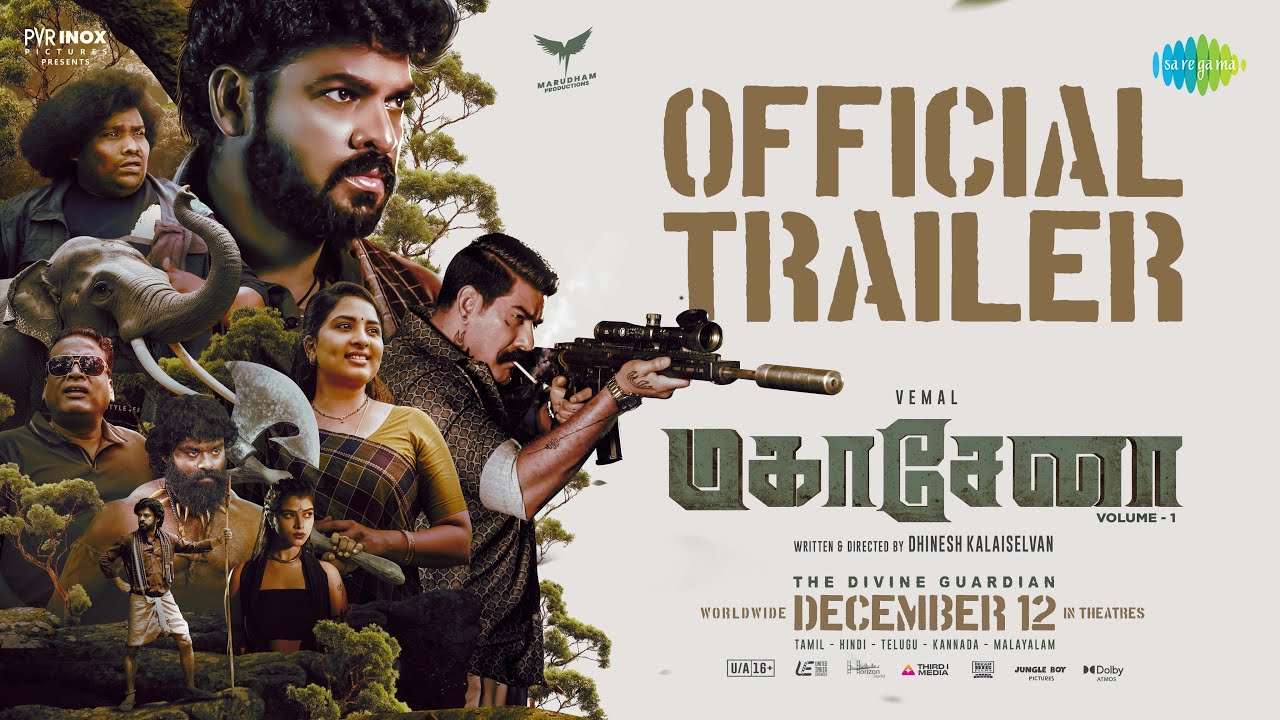
Synopsis: Set in the dense, mist-covered hills of Kurangani, Mahasenha revolves around a tribal community fiercely protecting their sacred Yaazheeswaran deity statue. At the heart of it stands Mahasena, a devoted tribal leader whose life revolves around faith, his people, his daughter, and his elephant. When corrupt officials, opportunistic villains, and curious outsiders enter the forest, belief clashes with greed, triggering a chain of conflicts that test both divinity and humanity.
| Department | Details |
|---|---|
| Director | Dhinesh Kalaiselvan |
| Writer | Dhinesh Kalaiselvan |
| Lead Actor | Vemal |
| Key Supporting Cast | Srushti Dange, Yogi Babu, John Vijay, Kabir Duhan Singh, Dr Alfred Jose |
| Genre | Mythological Jungle Thriller |
| Release Date | December 12, 2025 |
Script Analysis – Ambition Overwhelms Clarity
On paper, Mahasenha has a solid mythological backbone. The idea of a cursed deity, forest-bound faith, and a tribal protector is inherently cinematic. The problem begins when the screenplay tries to juggle too many ideas without giving any one of them enough breathing space.
The narrative jumps between tribal rituals, political corruption, college trekking groups, human sacrifice lore, and forest action without smooth transitions. Instead of flowing organically, scenes often feel like standalone segments stitched together.
The emotional throughline — Mahasena’s inner journey — remains undercooked. We understand his devotion, but we rarely feel his internal conflict deeply.
Takeaway: Strong core idea, but the screenplay lacks narrative discipline.
Character Arcs – Interesting on Surface, Shallow Beneath
Mahasena, played by Vemal, is designed as a righteous tribal guardian. While Vemal brings sincerity to the role, the character itself rarely evolves. He starts devoted, remains devoted, and ends devoted — without meaningful internal transformation.

Srushti Dange’s character exists more as a presence than a participant. Her emotional potential is never fully explored.
Yogi Babu’s trekking guide character provides occasional humour, but tonally clashes with the darker mythological elements. His arc feels disconnected from the main conflict.
The antagonists — John Vijay’s corrupt officer and Kabir Duhan Singh’s villain — are loud and functional, but lack psychological depth. They exist to push the plot, not enrich it.
Insight: Characters serve the plot, but the plot never serves the characters.
Thematic Depth – Faith, Fear & Forest Lore
Mahasenha attempts to explore powerful themes: coexistence between humans and nature, blind faith versus moral righteousness, and the exploitation of belief systems.
The film frequently hints that superstition can be both protective and destructive. Unfortunately, these ideas are stated more than they are explored.
Moments involving rituals and the sacred idol create intrigue, but the mythology behind Yaazheeswaran never feels fully fleshed out. Viewers are asked to believe without being truly immersed in the lore.
Takeaway: The themes are meaningful, but the world-building is incomplete.

The Climax Impact – Emotionally Muted, Visually Loud
The climax aims to be spiritually explosive, blending action, belief, and consequence. Visually, it delivers scale and intensity.
Emotionally, however, it falls short. Because character arcs are underdeveloped, the final resolution lacks catharsis. You understand what’s happening, but you don’t necessarily feel it.
The ending reinforces the moral stance of the film but doesn’t leave a lingering emotional echo.
Insight: The climax looks powerful, but doesn’t hit the heart hard enough.
| Screenplay Strengths | Screenplay Weaknesses |
|---|---|
| Unique mythological premise | Disjointed narrative flow |
| Atmospheric forest setting | Weak emotional buildup |
| Spiritual undertones | Too many subplots |
| Visual imagination | Inconsistent tone |
Writer’s Execution – Vision Without Refinement
As both writer and director, Dhinesh Kalaiselvan’s vision is clear — he wants to tell a rooted, myth-heavy story with commercial appeal.
Where the execution falters is in restraint. The script needed tighter focus, fewer characters, and stronger emotional anchors.
Dialogues swing between spiritual seriousness and accidental humour. Some lines work, others pull you out of the moment.
Takeaway: A bold vision that needed sharper storytelling tools.

| Aspect | Rating (Out of 5) |
|---|---|
| Story Depth | 2.5 |
| Screenplay Structure | 2.5 |
| Visual Support | 3.5 |
| Emotional Connect | 2.5 |
Final Story Verdict – What Works, What Doesn’t
Mahasenha is not a bad story — it’s an unfinished one. There’s sincerity, ambition, and cultural texture embedded within the narrative.
But the lack of coherence, emotional grounding, and character growth prevents it from becoming the gripping mythological thriller it wants to be.
This is a film that might resonate with viewers who enjoy raw ideas and forest mysticism more than polished storytelling.
FAQs
Is Mahasenha heavily story-driven?
The film has a strong premise, but the storytelling is fragmented and uneven.
Does the movie explain its mythology clearly?
The mythological elements are intriguing but not fully explored or detailed.
Is the climax satisfying story-wise?
Visually yes, emotionally it feels underwhelming.
Ratings are purely my take after multiple watches — your experience might differ!