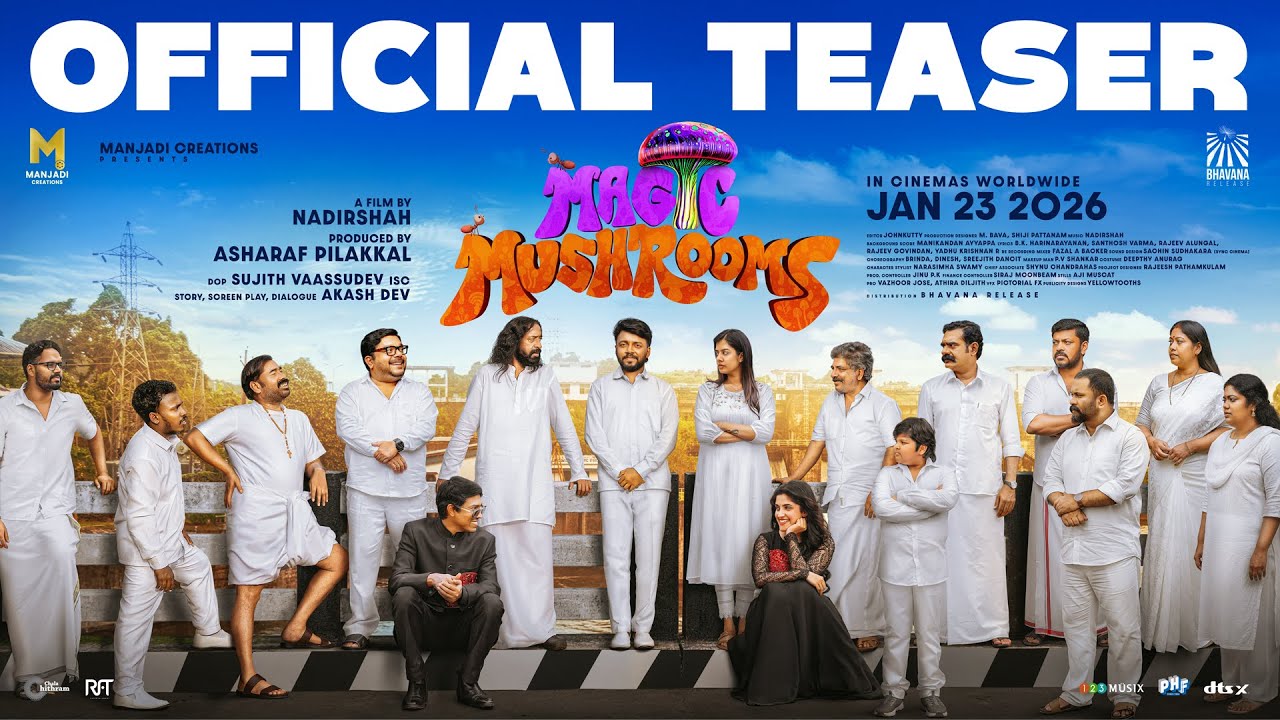
Magic Mushrooms Movie 2025 Movierulez Review Details
Magic Mushrooms Review – A Whimsical Trip or a Forced Comedy? The Real Analysis

As a critic who has seen folklore comedies swing from sublime to silly, I walked into *Magic Mushrooms* with one question: can Nadirshah’s signature humor truly blend with fantasy, or does the film get lost in its own psychedelic plot?
The Core Conflict
🎬 Book Movie Tickets Online
Check showtimes, seat availability, and exclusive offers for the latest movies near you.

In the serene village of Kanjikkuzhi, a cluster of bizarre, glowing mushrooms triggers supernatural chaos—talking animals, floating objects, and wild time loops.
A group of friends, led by an everyman (Vishnu Unnikrishnan), must unravel the mystery, clashing ancient folklore with clumsy scientific inquiry while navigating hilarious personal mishaps.
| Role | Name |
|---|---|
| Director | Nadirshah |
| Lead Actor | Vishnu Unnikrishnan |
| Female Lead | Akshaya Udayakumar |
| Writer | Akash Dev |
| Cinematographer | Sujith Vaasudev |
| Music Director | Nadirshah & Manikandan Ayyappa |
Who Is This Movie For?
This is a film squarely aimed at families and viewers seeking undemanding, feel-good entertainment. If you enjoy Nadirshah’s brand of broad, character-driven humor and have a soft spot for light fantasy rooted in Kerala’s folklore, you’re the target.
It’s a theatrical outing for those prioritizing consistent laughs over narrative rigor or visual spectacle.
Fans of Vishnu Unnikrishnan’s comic timing and ensemble-driven village comedies will find comfort here. However, viewers seeking sophisticated fantasy, tight plotting, or high-concept VFX will likely feel the experience is undercooked.
Script Analysis: The Flow of Fungal Chaos
Akash Dev’s screenplay operates on a simple, effective premise: introduce a magical catalyst and let an ensemble of quirky characters react. The initial act is strong, efficiently establishing the village dynamics and the bizarre rules of the mushrooms.
The humor derives from character, not just situation—Jaffer Idukki’s hallucinatory episode is a standout.
However, the middle section reveals the script’s primary weakness: meandering. Subplots involving romantic tensions, outsider rivalries, and familial reconciliations are introduced but often resolved with predictable, saccharine beats.

The pacing stumbles as it tries to service its large cast, causing the central mystery to occasionally lose momentum.
The fusion of folklore and pseudo-science is charming but surface-level. It serves as a functional engine for gags rather than a theme explored with any depth. The logic is deliberately loose, asking the audience to embrace the silliness fully.
Character Arcs: Growth Through Giggles?
Vishnu Unnikrishnan’s protagonist follows a reliable arc from skeptical observer to communal leader. His growth is tied to accepting the village’s mystical heritage, a metaphor for reconnecting with roots. It’s not groundbreaking, but Unnikrishnan sells it with earnest charm.
Akshaya Udayakumar, as the rational outsider, provides a necessary counterpoint. Her arc from skeptic to believer is the emotional through-line, though it could have used more screen time to feel fully earned.
The supporting cast, including Harisree Ashokan and Bijukuttan, are less about transformation and more about delivering reliable comic types.
Their collective function is to embody the film’s core theme: community. The ‘arc’ is ultimately the village’s, moving from chaotic individualism to harmonious unity, a journey facilitated by magic mushrooms rather than profound internal change.
The Climax Impact: A Satisfying Resolution?
The climax, a communal ritual to appease the guardian spirit, succeeds as a feel-good, visually vibrant set-piece. It smartly avoids a generic villain confrontation, focusing instead on cooperation and cultural restoration.
The resolution ties the plot threads together neatly, delivering emotional payoff for the central relationships.
Does it satisfy? For its target audience, absolutely. It provides a hearty dose of sentiment and laughter, wrapping up the fungal madness with a warm, unambiguous bow.

For those craving narrative surprise or thematic complexity, the ending may feel too safe and conventional. It prioritizes heart over ambition, which is the film’s defining choice.
| What Worked | What Didn’t |
|---|---|
| Strong ensemble comic timing | Meandering middle-act pacing |
| Charming folklore-meets-comedy premise | Predictable fantasy tropes |
| Efficient, heartwarming climax | Underdeveloped romantic subplot |
| Clear thematic focus on community | Surface-level treatment of its mythos |
Writer’s Execution: Dialogue & Tone
Akash Dev’s dialogue is the film’s engine. It’s consistently punchy, rooted in Malayali colloquialisms, and expertly delivered by a cast adept at comic timing. The exchanges feel natural within the exaggerated reality, selling the absurdity of the premise.
Where the writing stumbles slightly is in tonal balance. The shifts from broad slapstick—mushroom-induced dances, shape-shifting gags—to moments of sincere emotion can feel jarring.
The dialogue excels in comedy mode but becomes noticeably generic during sentimental beats, relying on familiar platitudes about family and tradition.
Miss vs Hit Factors: Why It Works (And Where It Doesn’t)
The hit factor is undeniable: chemistry. Nadirshah orchestrates his veteran ensemble like a maestro, allowing interactions between the likes of Johny Antony, Santhivila Dinesh, and Jaffer Idukki to sparkle with authentic, chaotic energy. This chemistry buoys the film through its weaker passages.
Another hit is its visual identity. Sujith Vaasudev’s cinematography bathes Kanjikkuzhi in an inviting, lush glow, making the fantasy elements feel organic to the setting. The technical craft supports the story without overpowering it.
The miss is a lack of narrative ambition. The film plays it exceedingly safe. The fantasy elements are a backdrop for standard comedic and emotional beats seen in countless village comedies.
It misses opportunities to delve deeper into its own intriguing mythology or to use its premise for more inventive, sustained satire.
Technical Brilliance: Crafting a Whimsical World
Sujith Vaasudev’s cinematography is a highlight, using dynamic tracking shots for chaotic chases and wide, serene frames to showcase the village’s beauty. The ethereal glow of the mushrooms is achieved with a pleasing mix of practical lighting and subtle VFX.

Sound design by Arun Prasad is clever and immersive. The whimsical foley—giggling fungi, mystical whispers—adds a layer of charm without being distracting.
Nadirshah and Manikandan Ayyappa’s music serves the film well; the songs are integrated smoothly, and the background score uses twinkling motifs to accentuate the magic and comedy effectively.
Editing by John Kutty is generally sharp, maintaining a brisk pace for gags, though it can’t fully conceal the script’s mid-act sprawl. The technical package is cohesive, creating a polished, family-friendly aesthetic that never feels cheap.
| Aspect | Rating & Comment |
|---|---|
| Story Originality | 7/10 – Fresh premise, familiar execution. |
| Visual Appeal | 8/10 – Lush, vibrant, and professionally crafted. |
| Character Depth | 6/10 – Likable but largely archetypal. |
| Emotional Payoff | 8/10 – Effectively heartwarming and satisfying. |
| Overall Entertainment | 7.5/10 – A consistent, enjoyable family ride. |
Frequently Asked Questions (FAQs)
Is there a villain in Magic Mushrooms?
No. The conflict arises from the chaotic effects of the mushrooms and the villagers’ initial misunderstanding. The resolution is about restoring balance with nature and folklore, not defeating an antagonist.
How are the visual effects?
They are modest but effective. The film relies more on practical effects, clever cinematography, and sound design to sell the magic. The VFX that exists serves the story without aiming for blockbuster spectacle.
Is it a standalone film or will there be a sequel?
The story is conclusively wrapped up as a standalone narrative. However, the world and characters are vibrant enough that a sequel exploring other folkloric elements is certainly possible if the film is a commercial success.
This analysis is based on the theatrical experience and cinematic merit.