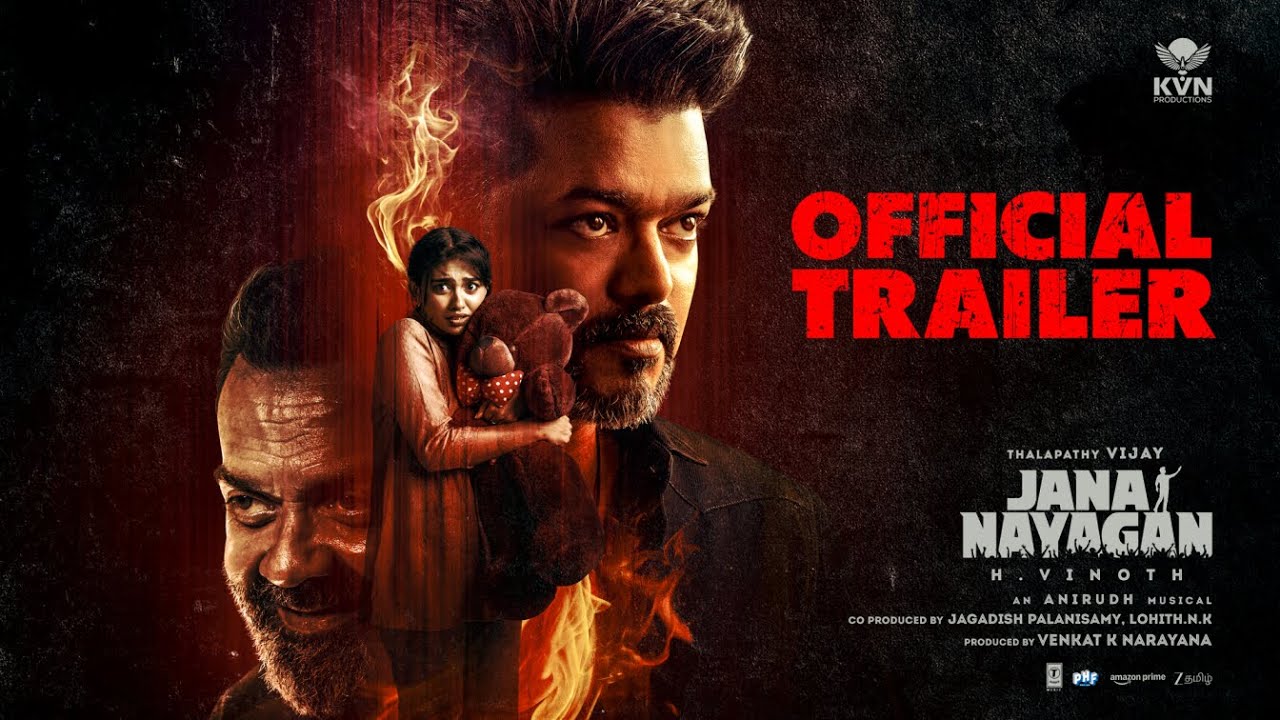
Jana Nayagan Vijay Thalapathy Movie 2026 Movierulez Review Details
Jana Nayagan Vijay Thalapathy Review – A Political Swan Song or Just a Crowd-Pleasing Spectacle? The Real Analysis

As the curtains closed on my screening, one question lingered: Did I just witness a cinematic manifesto or the most expensive victory lap in Tamil cinema history?
🎬 Book Movie Tickets Online
Check showtimes, seat availability, and exclusive offers for the latest movies near you.

Jana Nayagan follows Vetri Kondan, a fiercely principled IPS officer, as he declares war on a vast, shadowy nexus of corrupt politicians, corporate moguls, and black-money kingpins.
His quest for justice intertwines with Kayal, a tenacious journalist, leading to a high-stakes battle that aims to awaken the conscience of a nation.
| Role | Name |
|---|---|
| Vetri Kondan ‘Thalapathy’ IPS | Thalapathy Vijay |
| Kayal | Pooja Hegde |
| Antagonist | Bobby Deol |
| Director & Writer | H. Vinoth |
| Music Composer | Anirudh Ravichander |
| Cinematographer | Sathyan Sooryan ISC |
Who Is This Movie For?
This film is a direct feed for the Vijay faithful, offering a potent, larger-than-life distillation of his on-screen persona and off-screen political aspirations. It’s for audiences craving a socio-political action thriller with scale, where the hero’s swagger is as important as the message.
Political drama enthusiasts will find familiar Vinoth trademarks. However, those allergic to runtime bloat or seeking nuanced character work may feel the film’s ambitions outpace its execution.
Script Analysis: The Weight of Ambition
H. Vinoth’s screenplay is a double-edged sword. Its strength lies in a clearly articulated, relevant conflict—corruption, electoral fraud, public apathy. The plot mechanics, involving money trails and media manipulation, have a contemporary sheen.
Yet, the narrative flow is frequently disrupted. The three-hour-plus runtime accommodates not just action, but lengthy expositions on governance that feel like political pamphlets inserted into the drama.
Pacing is inconsistent. The film moves in jerks: a thrilling action sequence, then a static dialogue-heavy scene explaining the previous thriller. This stop-start rhythm prevents the story from building seamless, organic momentum.

Character Arcs: Icon Over Individual
Vijay’s Vetri Kondan is less a character with an arc and more an immutable force of nature. He begins as the people’s hero and ends as the people’s legend. The transformation is in his scale of influence, not his internal self.
This iconic presentation is electrifying for fans but leaves little room for vulnerability or genuine growth. Bobby Deol’s antagonist is menacing but functionally one-note—a symbol of evil capital.
Pooja Hegde’s Kayal has agency as a journalist but is sidelined into a romantic track that feels perfunctory.
The supporting cast, including Gautham Vasudev Menon and Prakash Raj, serve as archetypes—the mentor, the schemer—adding texture to the world but not necessarily depth to the narrative.
The Climax Impact: Catharsis by Scale
Does the ending satisfy? For its target audience, overwhelmingly yes. The climax is a technical marvel, a massive Chennai-set showdown designed for collective theater cheering.
It delivers visceral, spectacular catharsis. Thematically, it hammers home the film’s central idea of popular uprising. However, from a purely narrative standpoint, it follows a predictable trajectory. The victory feels earned by star power and sheer will, rather than by intricate plotting.
It succeeds as a mass elevation moment, cementing the ‘Jana Nayagan’ legend, even if it doesn’t surprise as a piece of storytelling.
| What Worked | What Didn’t |
|---|---|
| The core, relevant political premise | An overlong, bloated runtime |
| High-stakes, well-defined conflict | Inconsistent, stop-start pacing |
| Mass-oriented, punchy dialogue moments | Lengthy expository political speeches |
| Clear, audience-pleasing hero trajectory | Underdeveloped romantic subplot |
Writer’s Execution: Dialogue of Two Realms
H. Vinoth’s dialogue operates in two distinct registers. The first is sharp, mass-friendly punch dialogue tailored for Vijay—lines meant to be roared back by the audience. These land with intended force.

The second register is dense, explanatory prose about policy and corruption. These exchanges, often between politicians or in courtrooms, are information dumps. They strive for gravity but sap cinematic energy, feeling more didactic than dramatic.
The contrast between these modes is jarring. The script shines in moments of confrontation but stumbles in its need to lecture.
Miss vs Hit Factors: The Tightrope Walk
The hit factor is undeniable: Vijay’s commanding, career-capping performance fused with a timely political theme and mounted on an unprecedented scale. Anirudh’s anthemic score acts as a relentless adrenaline pump. This synergy creates iconic moments that will define his filmography.
The miss factor is the lack of discipline. The film’s need to be everything—action thriller, political treatise, romantic drama, mass musical—leads to narrative sprawl. At 186 minutes, it tests patience, with subplots that could have been trimmed for a sharper impact.
The final product is a spectacular, flawed monument. It hits as an event but misses the taut brilliance of a finely-tuned thriller.
Technical Brilliance: A Sensory Overload
This is where Jana Nayagan soars. Sathyan Sooryan’s cinematography is opulent and dynamic, painting both gritty action and political grandeur with a vivid palette. The production design by V. Selvakumar creates a believable world of corrupt opulence.
Anirudh Ravichander’s background score is the film’s relentless heartbeat. The sound design and Dolby Atmos mix are immersive, making every punch and crowd roar visceral. Anal Arasu’s action choreography is stylish and brutal, designed for maximum big-screen impact.
While the VFX is largely impressive for scale, some composite shots in massive crowd scenes reveal the green screen, a minor blemish on an otherwise technically pristine canvas.

| Aspect | Rating / Comment |
|---|---|
| Story & Theme | 8/10 – Potent and relevant, but narratively bulky. |
| Visual Spectacle | 9.5/10 – Top-tier Indian cinema craft. |
| Pacing & Editing | 6/10 – The film’s most significant weakness. |
| Audio-Score Impact | 10/10 – Anirudh elevates every frame. |
| Character Depth | 6.5/10 – Functional archetypes over deep individuals. |
| Overall Cinematic Experience | 8/10 – Flawed, unforgettable, and massive. |
Frequently Asked Questions (FAQs)
Is Bobby Deol’s villain effective? Yes, in a broadly menacing way. He embodies cold, corporate evil effectively, though the role doesn’t demand great complexity.
How is the chemistry between Vijay and Pooja Hegde? It is adequate but underutilized. The romantic track feels like a contractual obligation rather than an integral part of the core plot.
Does the film end with a sequel setup? No. It concludes as a definitive, self-contained chapter, providing a satisfying, full-stop conclusion to Vetri Kondan’s crusade and serving as a symbolic curtain call for Vijay’s acting career.
This analysis is based on the theatrical experience and cinematic merit.